
Battery degradation: what you can measure yourself, and what you can't
What degradation means, how usable capacity is estimated from your own charges, why the estimate moves, and what only a certified battery test can tell you.
On this page
Every electric car battery slowly loses some of its capacity over the years, a process known as degradation. Owners want to know where theirs stands, for peace of mind, before a long trip, or before selling the car. The good news is that you can follow a large part of it yourself. The honest news is that a figure computed at home is an estimate, and it should be read as one.
What “battery health” means
Battery health, often written SOH for state of health, compares the energy the battery can store today with the energy it could store when new. A battery at 95% can hold 95% of its original capacity: it has lost 5% to degradation.
Two details matter:
- Usable capacity, not gross capacity. Carmakers keep part of the battery out of reach, as a buffer that protects it. What you drive with is the usable capacity, and that is the one worth following.
- Capacity is not range. Range also depends on speed, temperature and driving. A lower range in winter says little about the battery’s health.
Three ways to measure it
- The car’s own indication. Some cars show a battery health figure or let you run a test. Availability depends on the model and on the software version.
- A certified test. A garage or an independent provider reads the battery management data, sometimes with a full charge and discharge, and issues a report. This is what you need when buying or selling a used car.
- An estimate from your own charges. By comparing the energy added during a charge with the change in charge level, you can estimate the usable capacity, charge after charge.
How an estimate from your charges works
Method
Usable capacity ≈ energy added to the battery (kWh) ÷ increase in charge level (as a decimal: 0.60 for 60 points)
Example
A session adds 45 kWh while the charge level goes from 20% to 80%, that is 60 points.
Estimated usable capacity: 45 ÷ 0.60 = 75 kWh.
The method only works well under some conditions:
- A wide charge window. Over a few points, rounding of the charge level weighs too much. The larger the window, the more reliable the result.
- Energy measured on the battery side. The energy drawn from the wall includes charging losses and would overestimate the capacity.
- Several charges, not one. Each estimate carries an uncertainty. A trend over weeks and months says much more than a single value.
Why the number moves
It is normal for the estimate to go up and down a little:
- Temperature: a cold battery accepts and reports energy differently.
- Calibration of the battery management system: the car’s own estimate of the charge level drifts and corrects itself over time, often after a charge to a high level or a deep discharge.
- Short or unusual sessions: a charge interrupted early, or a session where the car used a lot of energy for heating, gives a less reliable estimate.
An estimate that drops one day and comes back the next week is not a sign of a problem. Look at the trend.
When a certified test is the right tool
An estimate built at home is enough to follow your own car. It is not a document you can hand to a buyer, and it does not replace the procedure set out in your battery warranty, which usually defines a minimum capacity over a given period. For those cases, a certified test is the reference. If you drive a Tesla, our guide to checking your Tesla’s battery health gives the figures for normal degradation and the warranty terms.
What Voltessa does
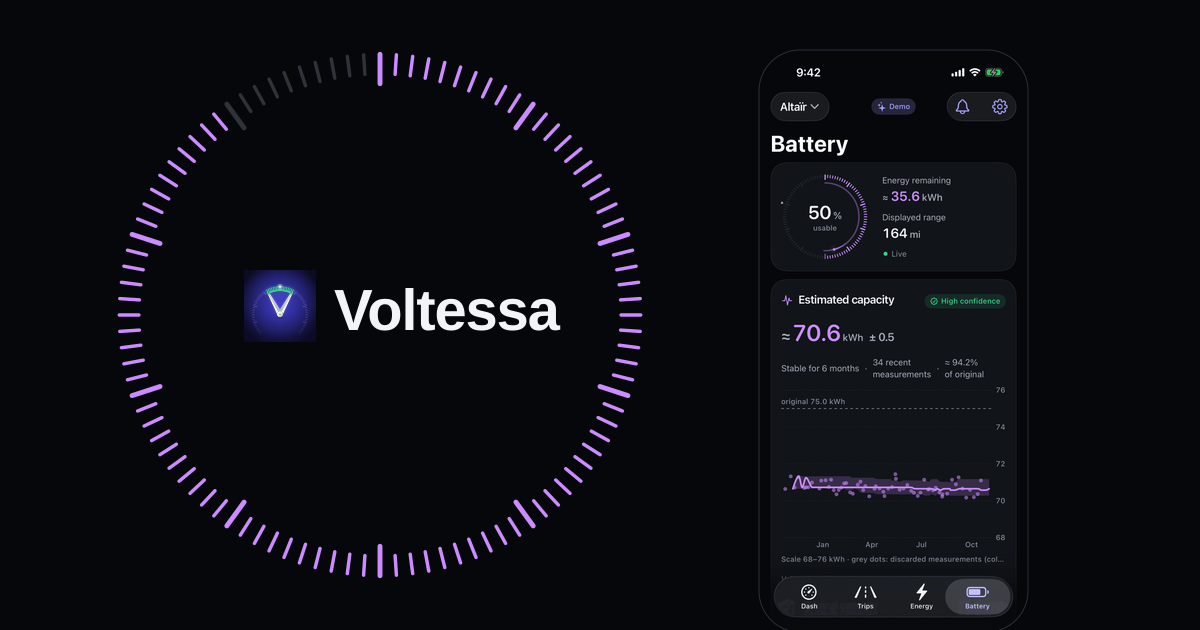
Voltessa estimates the usable capacity after each significant charge, with the margin of the estimate and the method used. The trend builds over time, and a health percentage only appears once the estimate is reliable enough. It is an estimate built from your car’s charging data, not a certified battery test, and the app says so.
Voltessa works with Tesla vehicles, on iPhone, iPad, Mac and Apple Watch. To see where the energy goes after charging, read our guide to understanding your car’s consumption.
Related articles
Checking your Tesla's battery health
The car's own Battery Health screen and test, a certified report, or your charging data: three ways to check a Tesla battery, normal loss and the warranty.
How much does it cost to charge a Tesla?
What a Tesla charge really costs at home and at a Supercharger: the formula, charging losses, off-peak hours, Supercharger prices and fees, and the invoice.

Your Tesla's real-world consumption and the Energy app
Where your Tesla shows its consumption in Wh/mi or Wh/km, why the range on screen differs, and what makes it vary: speed, cold, short trips, climate.